



Why the advantages of A-Levels begin with depth, not volume
One of the biggest misunderstandings about A-Levels is that they are “just” a way of narrowing subject choice. In reality, that specialisation is exactly where much of their educational value begins. UCAS describes A-Levels as subject-based qualifications normally studied over two years, with students usually taking three or more subjects. Pearson similarly highlights depth, strong academic skills, analytical ability, research and problem-solving, while Cambridge International stresses deep subject understanding and independent thinking. In other words, the structure is not a limitation by default; it is a framework for depth.
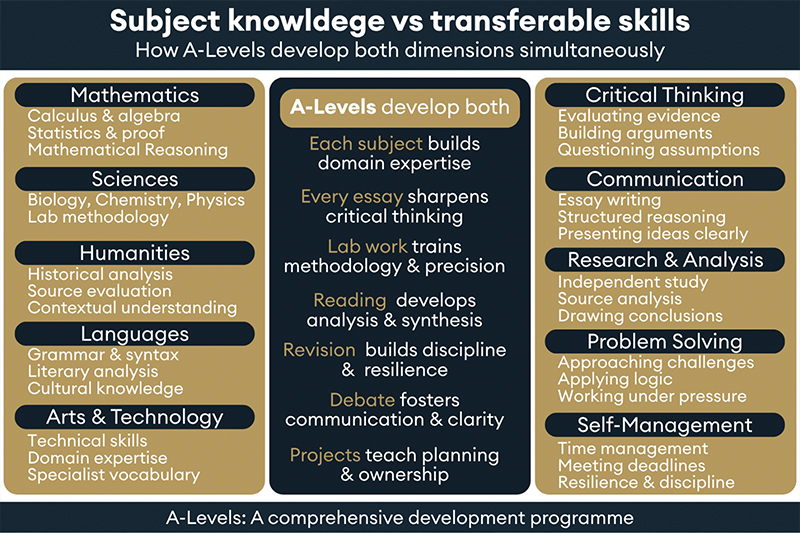
That matters because depth changes the way students learn. When a young person spends two years working seriously within a smaller group of demanding subjects, they do not simply memorise more content. They practise returning to ideas, refining arguments, testing methods, evaluating evidence and improving the clarity of their thinking. A broader curriculum can certainly be valuable, but breadth is not the only route to becoming well educated. Repeated depth also builds maturity.
For parents, this is an important shift in perspective. The right question is not only, “How many subjects does my child study?” It is also, “What habits of mind does this curriculum create every day?” In strong A-Level settings, students learn to work with complexity, tolerate challenge, organise themselves and speak with greater precision. Those are not side benefits. They are part of the core educational gain.
At Virtus College, that principle is made explicit. The school’s teaching approach is grounded in active learning and is designed to help students think critically, communicate confidently and take ownership of their academic journey. Its published educational aims also include independence, oral expression, intellectual curiosity and a global outlook, which means these skills are not treated as nice extras but as part of the daily purpose of Sixth Form life.
A-Levels and critical thinking skills: what students really learn
Critical thinking is one of those phrases parents hear constantly, but it only becomes meaningful when we define it clearly. In practice, critical thinking means being able to examine evidence, spot weaknesses in an argument, compare interpretations, apply knowledge to new situations, make sound judgements and explain a conclusion logically. That description is not a vague aspiration imposed onto A-Levels from outside. Cambridge International explicitly says its AS and A-Level curriculum develops independent thinking, evaluation of information sources, logical argument, judgement and reasoned explanation, while Pearson emphasises analytical, research and problem-solving abilities.
In science and mathematics
In STEM subjects, critical thinking rarely looks theatrical. It often looks quiet and precise. A student works out why a method failed, interprets data, questions assumptions in a model, decides whether an answer is reasonable or compares two possible approaches to the same problem. The student who becomes good at this is not just becoming “better at science” or “better at maths”. They are learning how to reason under constraint.
This is one reason A-Levels can be such good preparation for selective university courses. They force students to move beyond passive agreement and into disciplined judgement. A strong answer is not built around “I think”; it is built around “the evidence suggests”, “this follows because”, or “this interpretation is weaker for these reasons”. That habit is academically powerful. It is also personally maturing.
In essay-based subjects
In humanities and essay-based subjects, critical thinking becomes even more visible. Students are expected to handle different sources, build an ordered line of argument and communicate clearly. Cambridge’s curriculum language around coherent arguments, reasoned explanations and making judgements captures exactly why essay-based A-Level work can be so intellectually formative. It is not only about learning facts. It is about learning how to use them properly.
This matters especially for parents who worry that a specialised curriculum might be too narrow to develop a “well-rounded” mind. In reality, thinking well is one of the most transferable skills a student can develop. A-Level depth does not reduce intellectual challenge. In the best cases, it intensifies it. Students become more discerning readers, more careful writers and more rigorous speakers because they are repeatedly asked to defend conclusions rather than merely repeat information.
At Virtus College, this is reinforced beyond the classroom. Active learning is used to deepen understanding and encourage students to think critically and communicate confidently. On top of that, debating is a compulsory part of Year 12, designed to build oracy, persuasive argument and performance under pressure through discussion of political, social and economic issues. That is a very direct route from curriculum to critical thinking in action.
A-Levels and advanced academic English: beyond conversational fluency
For international families, one of the most underestimated advantages of A-Levels is language. Not just “speaking English”, but thinking, reading, writing and responding in academic English every day. The British Council’s description of English for Academic Purposes is useful here: academic English is the language students need for study and research, including classroom interactions, seminar discussion, assignments and exams. That is a long way beyond casual fluency.
This distinction matters because many students already have decent conversational English by Sixth Form. The bigger question is whether they can read dense material, understand specialist vocabulary, write analytical responses, speak persuasively in class and perform under exam conditions in English. Those are the skills that shape university readiness. A student may sound fluent socially and still feel underpowered academically. A strong A-Level experience closes that gap.
When content subjects are taught through a language that is not the student’s mother tongue, the language becomes the medium of real thinking, not just a separate lesson. The British Council notes that this kind of long-term bilingual learning supports natural language development and that learners in a good bilingual programme become academically proficient in English over time.
That is why studying A-Levels fully in English can have such a profound effect. Students are not only “taking English classes”. They are processing economic concepts, scientific reasoning, historical interpretation or literary argument through English. Cambridge International’s curriculum framework goes so far as to list “working and communicating in English” among the skills developed through AS and A-Level study. Over two serious academic years, that repeated exposure builds subject-specific vocabulary, more precise writing and much greater confidence in academic discussion.
It is also why families often notice a change that is hard to measure in a single line on a report. By the end of Sixth Form, many students do not just have better English; they have more academic control in English. They know how to answer an exam question, structure an essay, challenge a point respectfully, or explain an idea under time pressure. For many learners, that amounts to a near-bilingual level of academic confidence, even if perfection remains a moving target.
A-Levels, research skills and learning how to learn
Another major added value of A-Levels is that they push students towards self-direction. Pearson says A-Levels encourage independent thinking, structured study habits and deeper understanding, while UCAS publishes study-skills resources specifically to help students build the habits of effective independent study before higher education. This is a crucial point: strong A-Level preparation is not just about absorbing teacher explanations. It is about gradually learning how to organise one’s own progress.
This is where the phrase “learning how to learn” becomes real. Students have to decide how to revise, how to break down long tasks, how to read for meaning, how to improve weak areas and how to sustain effort over time. These are not glamorous skills, but they are the backbone of university success. Students who arrive at higher education without them often struggle, even when they are bright. Students who already possess them adapt faster.
The research dimension matters too. Cambridge International explicitly includes handling and evaluating different information sources, making judgements and communicating reasoned explanations within its AS and A-Level curriculum. Those are research habits in embryo. They teach students not to treat the first source they read as the truth, but to compare, question, refine and justify. That intellectual independence is one of the clearest differences between school-level compliance and pre-university maturity.
At Virtus College, this is reinforced through specific structures. Students can pursue the EPQ, which it describes as developing independent research skills, critical thinking, academic writing and reading, and mirroring the skills needed to thrive at university. Every student is expected to complete a non-curricular book and a MOOC each year, while weekly mentoring helps students with organisation, study techniques, wellbeing and university planning. That is a very practical version of “learning to learn”.
There is also an important emotional side to this. Self-directed learning builds initiative. A student begins to see that progress is not something delivered to them; it is something they shape. That change in mindset can be transformative. It creates more confidence, but also more responsibility. In strong Sixth Form environments, students stop asking only, “What do I need for the next test?” and start asking, “How do I build the habits that will carry me further than the next test?”
A-Levels, creativity and communication: the softer skills that matter
A common misconception is that A-Levels are academically strong but personally narrow. That view misses how much creativity and communication can be built through the programme when a school teaches it well. Some of this comes from subjects themselves: Art & Design, English Literature, Media and project-based scientific or humanities work all demand interpretation, originality and style. Some of it comes from the format of high-level classroom discussion, presentations and written argument. And some of it depends on the school culture around the qualification.
These softer skills are not marginal in 2025. The World Economic Forum’s Future of Jobs Report 2025 says analytical thinking remains the most sought-after core skill among employers, while creative thinking, resilience, flexibility and lifelong learning are also rising in importance. So when A-Levels develop reasoning, expression and intellectual agility, they are not only preparing students for exam success. They are also building capabilities the wider world increasingly rewards.
At Virtus College, the Enrichment Programme is designed precisely around this broader development. The programme equips students with highly transferable skills such as public speaking, research techniques, critical thinking and the ability to analyse complex issues. Some concrete examples: journalism, politics and international relations, coding, biomedical sciences, finance, entrepreneurship and debating. In other words, students are encouraged to grow beyond the classroom while still strengthening their academic and vocational profile.
Communication skills also grow through responsibility and community. Virtus College describes leadership opportunities that allow students to shape school life, practise decision-making and serve the community, while student clubs and societies are designed to build confidence, initiative and belonging. A broader description of Virtus as a close-knit, pre-university environment where relationships matter is relevant here too. Students often communicate better not only because they are challenged more, but because they are known more.
That final point matters for families who worry that academic intensity may come at the cost of happiness or social confidence. A good A-Level education should not produce clever but hesitant young people. It should help students become articulate, grounded and socially capable. High expectations and happiness are compatible, having clubs, leadership, sport, houses and pastoral care as part of a thriving Sixth Form community. (virtuscollege.com)
A real Virtus College case: strong results, stronger oracy
The strongest educational claims are the ones that can be seen in real school life. In Virtus College’s published 2025 A-Level results, 71% of students achieved at least one A*/A and 42% of all grades were awarded at A*/A. That matters because it shows academic strength in measurable terms, not just in aspiration.
It also gives useful context to the school’s claim of added value. JCQ’s UK-wide 2025 press notice reports 249,675 A*-A grades out of 882,509 A-Level entries, which is about 28.3% across the system. That is not a perfectly identical like-for-like comparison with one school’s internal reporting, but it does provide a broad national benchmark. On that basis, Virtus College’s published figure of 42% of grades at A*/A sits above the wider UK picture.
But the more interesting part of the Virtus College case is that the school’s approach to spoken English and argumentation is clearly structural, not cosmetic. As previously mentioned, debating is compulsory in Year 12, that MUN is used to strengthen confidence, teamwork and oracy, and that IELTS is compulsory for every student to certify academic English for university applications. Preparation-for-university focus on coaching for essays, interviews and admissions tests, noting that this process develops critical thinking, self-expression and confidence in high-stakes settings.
Seen together, that is the real case study. The qualification gives depth. Active learning, debate, mentoring, enrichment and performance opportunities. The result is not only good grades, but students who can explain themselves well, think under pressure and sound more mature in academic English. That is exactly the kind of “added value” parents often struggle to see until they encounter it in real classrooms and real conversations. (virtuscollege.com)
Why these A-Level skills matter for university and beyond
Universities do not simply want students who can pass exams. They want students who can handle seminar discussion, extended reading, timed writing, evidence-based argument and independent study. The British Council’s definition of English for Academic Purposes includes classroom interactions, research genres, assignments and exams, which is a useful reminder that academic success depends on a bundle of habits, not a single grade. This is also why globally recognised IAL qualifications remain attractive: Pearson describes them as internationally recognised qualifications that open doors to top universities worldwide.
The same logic applies beyond higher education. Analytical thinking, creative thinking, resilience, self-awareness and lifelong learning are all rising in labour-market importance, according to the World Economic Forum. When students leave Sixth Form with depth in subject knowledge plus the ability to reason, research, write and speak with confidence, they are better equipped not just for the first term of university, but for the longer demands of adult professional life.
How parents can tell whether an A-Level school is genuinely developing these skills
A useful way to judge any A-Level provider is to look beyond headline grades and ask a more revealing set of questions:
- Do students regularly debate, present and defend ideas aloud?
- Are they writing analytically, not just completing worksheets?
- Is there visible support for independent study habits and mentoring?
- Are research, enrichment and stretch built into the programme?
- Is academic English developed intentionally, not left to chance?
- Does the school create a culture where confidence, belonging and intellectual challenge can coexist?
Those questions matter because the true value of A-Levels is not only what students know at 18, but how they have learned to think, communicate and grow by 18.
FAQs about the skills students develop through A-Levels
Do A-Levels develop critical thinking skills or just subject knowledge?
Yes. Official A-Level and AS/A-Level frameworks explicitly refer to independent thinking, analysis, evaluation of information sources, reasoned explanation, judgement and problem-solving. In a good school, that means students learn not only what to think about a subject, but how to think within it.
Do A-Levels help students improve their English?
They can do so very powerfully when subjects are studied fully in English. Academic English develops through reading, discussion, assignments and exams, not through conversation alone. Long-term bilingual study also supports academic proficiency and real communicative fluency.
Are A-Levels good preparation for university research and essay writing?
Yes. UCAS’s study-skills guidance focuses on argument, academic essay writing and independent study, while A-Level frameworks emphasise evaluating sources and communicating reasoned explanations. That combination is closely aligned with what students are later expected to do at university.
Are A-Levels too narrow compared with broader programmes?
Not necessarily. The trade-off is breadth versus depth, and depth has real educational value. For students who are ready to specialise, A-Levels can create stronger subject mastery, more independent thinking and more time to develop rigorous academic habits.
Can A-Levels also develop creativity and communication?
Absolutely. Creativity comes through interpretation, design, original thinking and project work, while communication grows through essays, discussion, debate, presentations and leadership opportunities. Schools that add enrichment and public speaking make these gains even more visible.
Why do some Virtus students seem especially confident speaking in English?
Because the school builds that confidence deliberately. Virtus College combines all-subject study in English with compulsory debating, IELTS, mentoring, enrichment and interview preparation. That gives students repeated opportunities to think, write and speak in academic English under real pressure.
Final thought
For families comparing post-16 pathways, the best question is not simply which curriculum looks impressive on paper. It is which curriculum helps a young person become sharper, more articulate, more independent and better prepared for life after school. That is where A-Levels often show their real strength. And in a specialist setting such as Virtus College, that strength can become visible not only in exam outcomes, but in the way students speak, argue, research and carry themselves.