



Why families need a country-by-country view of admissions
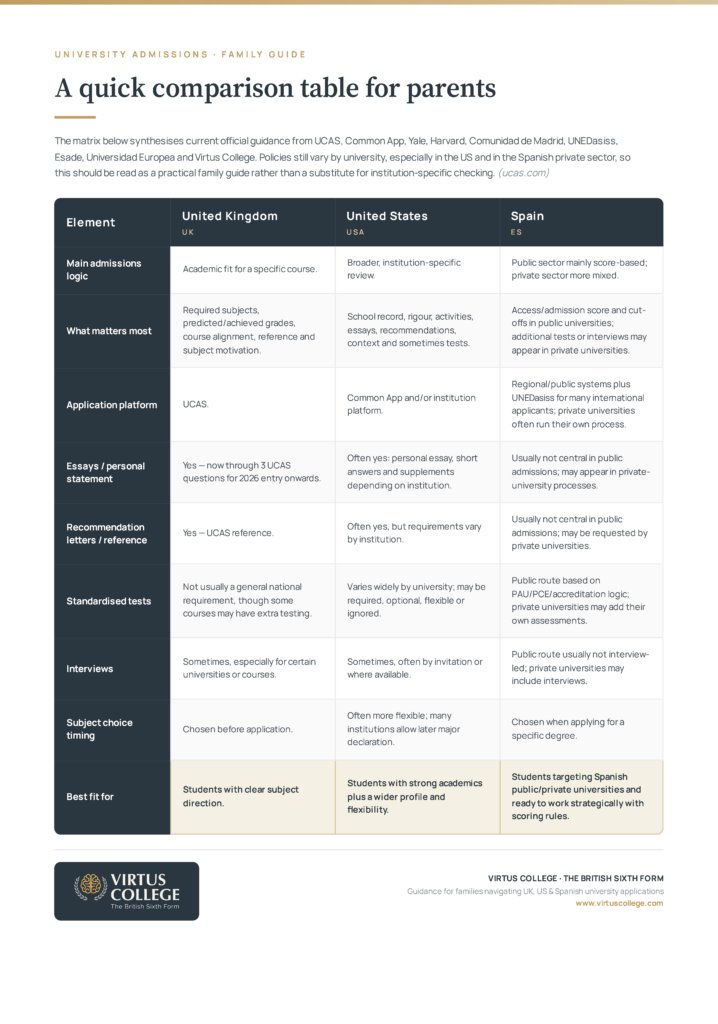
One of the most common sources of confusion for parents is that all three systems use familiar words such as grades, application, essay, interview and entry requirements, but they do not use them in the same way. In the UK, the application is largely built around academic fit for a specific course. In the US, the process is usually broader and more institution-specific. In Spain, public university entry is still primarily driven by admission scores and cut-offs, while private universities may layer on their own assessments. Good international university counselling starts by making those structural differences visible as early as possible.
That matters because the same student can look stronger or weaker depending on the system. A highly specialised applicant with clear subject direction may look immediately well placed for the UK. A student with a broader story, strong activities and a compelling personal voice may have more room to shine in the US. A student targeting Spain, especially the public sector, needs to understand how numerical access and admission scores actually work rather than assuming the process will be evaluated in a more holistic way.
For parents, the practical takeaway is simple: the question is not just Which university is right for my child? It is also: Which admissions logic best matches my child’s strengths, academic profile and decision-making style? That is the point at which strategic university guidance becomes genuinely valuable.
University admissions in the UK: academic, focused and course-specific
The UK model is usually the easiest to explain and the hardest to oversimplify. It is true that the process is more academically centred than the US model, but it is not only about grades. UCAS states that universities and colleges set their own entry requirements and that these usually involve a mix of qualifications, specific subjects and grades. It also explains that admissions teams may consider experience, subject motivation, references and contextual information alongside academic achievement. Even so, the system is clearly built around whether the student looks well prepared for a particular course from day one.
That course-specific logic is crucial. In the UK, the student is not normally applying to a university in a broad sense first and deciding later what they may want to study. They are usually applying to a defined course such as Law, Economics, Mechanical Engineering or English Literature. As a result, subject choice at Sixth Form level matters a great deal. UCAS also notes that applicants can submit up to five choices, with earlier equal-consideration deadlines for Oxford, Cambridge and most courses in medicine, dentistry and veterinary medicine/science.
There is another current detail parents should know. For 2026 entry onwards, UCAS has replaced the older single personal statement format with three structured questions. Those questions ask why the student wants to study the subject, how their qualifications and studies have prepared them, and what they have done outside formal education that is relevant to the course. UCAS also states that a reference is required before the application can be sent, and that referees may include predicted grades when relevant.
This is why the UK system often feels more efficient and more unforgiving at the same time. Efficient, because a strong applicant with the right A-Levels, a clear academic direction and convincing subject motivation can present a very coherent application. Unforgiving, because weak subject choice, vague course rationale or missing required preparation can quickly narrow the available options. That is especially relevant in competitive subjects where the offer may specify both grades and subjects, such as AAB with Chemistry and two other sciences or mathematics.
Interviews are also best understood as selective rather than universal. UCAS says interviews and auditions help course tutors compare applicants before deciding what offers to make, and not every applicant or course provider uses them. In practice, some of the most selective universities and courses use interviews much more intensively than the system as a whole.
For parents, the UK pathway therefore tends to reward students who already have a relatively clear academic identity by age 16 or 17. It favours evidence of subject depth, intellectual seriousness and a well-matched curriculum. That is one reason A-Levels align so naturally with UK admissions: the qualification itself is already built around academic depth and subject choice.
University admissions in the USA: broader, more holistic and more variable
The US model is broader, less centralised and more variable from one institution to another. Many, though not all, universities use the Common App, which says it serves more than 1,100 member colleges worldwide. The Common App first-year guide makes clear that applicants may need to provide a transcript, activities and responsibilities, test scores depending on policy, essays, and supporting documents from counsellors and recommenders. It also states that every college sets its own requirements for testing, writing, deadlines and recommendations.
That variability is one of the defining features of US admissions. The Common App requirements grid categorises institutional test policies in several ways, including always required, flexible, ignored, never required and sometimes required. In other words, there is no single national rule families can rely on. Even within highly selective admissions, policies differ from university to university. Yale, for example, currently describes its process as holistic and says applicants are reviewed in a whole-person, context-based manner; it also requires first-year applicants to submit scores from one or more of ACT, AP, IB or SAT under its current test-flexible policy.
This is where parents often underestimate the importance of the narrative side of the application. The Common App asks students to list activities, work and responsibilities, and explicitly says this is where they can show what makes them unique outside the classroom. It also explains that many colleges require or invite essays, short responses or writing supplements. Yale’s own admissions materials say transcripts, test scores, essays and recommendations all help paint a fuller picture of how the student has used the opportunities available to them.
That does not mean academics matter less. Quite the opposite. For international applicants from A-Level schools, the academic record remains foundational. What changes is that the US system tends to ask a broader question than the UK system does. Rather than focusing mainly on whether the student is already perfectly aligned to one degree path, it often asks what kind of scholar, contributor and community member the student may become on campus. That is why activities, essays and recommendations usually carry more strategic weight than they do in standard UK applications.
Another major difference is academic flexibility after entry. At many US universities, students are not required to lock in a final major immediately. Harvard states that incoming first-year students do not need to declare a major and that concentrations are officially declared in the fall of sophomore year. This kind of flexibility is one reason the US route can appeal strongly to students who are intellectually broad, undecided between fields, or excited by a liberal arts model.
Interviews also need to be understood differently from the UK. In the US, they are often institution-specific and not universally required. Yale says applicants do not request an interview but may be invited, and that not receiving an interview does not disadvantage the application. Harvard likewise states that interviews are assigned at the discretion of the Admissions Committee and that an application receives full evaluation even if an interview cannot be arranged.
For families, the US pathway usually suits students who can combine strong academics with initiative, personality, sustained interests and thoughtful self-presentation. It is more demanding in terms of application management because the number of moving parts is often higher, and because requirements vary so much by institution. That is exactly why strong international university counselling matters here: not to inflate a profile artificially, but to organise evidence, sequence deadlines and avoid treating all US universities as though they were looking for the same thing.
University admissions in Spain: score-driven in the public sector, more mixed in the private sector
Spain is often described by families as the most straightforward system, but that is only partly true. In the public university sector, admissions are indeed more numerical and formula-based than either the UK or the US. In the Comunidad de Madrid, for example, the access score is calculated as 40% PAU plus 60% Bachillerato, and the final admission mark can then be increased by weighted optional subjects. The same official guidance explains that universities use the admission mark to allocate places and that the optional component can add up to four more points depending on the weighting of the chosen subjects.
For students coming from foreign systems, the route is also clearly structured. The Comunidad de Madrid states that students from European systems and certain systems with international agreements can request credentialing or accreditation of their marks through UNEDasiss, and that they do not need to homologate their qualifications simply to access Spanish universities. It also explains that these students may raise their score through UNEDasiss PCE exams, recognition of relevant subjects from their own system, or the voluntary part of the PAU. UNEDasiss further states that universities may add up to four points to the initial admission score using the relevant formulas and that, although students can take up to six PCE subjects, two are enough for university application.
This is the part many international families need detailed explanation. In Spain, especially in the public route, admissions often feel less personal because the process is largely built around whether the student reaches the necessary score for the degree. The system is transparent in one sense, but it can also be unforgiving when families do not understand weightings, PCE subject strategy, or the difference between access and admission marks. That is why Spanish university guidance often becomes much more technical than parents initially expect.
The private university sector is different. Here, families should not assume the process will look like the public one. Esade says explicitly that it has its own admissions process, that its degrees do not have minimum entry grades in the same way public cut-off systems do, and that it assesses academic record, exam grades, the application, admissions tests and more. Universidad Europea likewise describes an admissions process for international pre-university students that can include a competencies test and a personal interview or motivational questionnaire.
So the most accurate way to explain Spain is this: public university admissions are predominantly score-driven; private university admissions may be substantially more individualised. Parents who only know one side of that picture can easily misunderstand what their child needs to prepare.
If you need more information about
Virtus College The British Sixth Form.
Fill in the following form and we will contact you within 24 hours.
If you prefer that we speak by phone, we will be happy to assist you at +34 605 844 968.
How Virtus College prepares students for all three pathways
This is where the article stops being theoretical. Virtus College is a university-focused British Sixth Form that prepares students for leading universities in the UK, the USA and beyond through a personalised two-year A-Level curriculum, Enrichment Programme and Mentoring. Its preparation-for-university focus on the following: students receive expert mentoring, early preparation and real-world experience. University counselling is embedded throughout school life rather than bolted on at the end.
In practice, that means students are not left to “figure out applications later”. Virtus College states that, whether students are applying to Oxford, Harvard or top European institutions, they receive coaching for personal statements, college essays, admissions tests such as SAT, PAT, MAT and UCAT, and interview training led by subject specialists. The school mentors also support students through regular one-to-one sessions. Over 90% of students say this increases confidence, motivation and academic performance, while 95% feel better prepared for university and future careers.
That cross-system preparation is visible in the destinations and experiences Virtus College publishes. On its official results and destinations page, the school lists 2025 destinations including Cambridge, Bath, Durham, King’s College London, Delft University of Technology, Eindhoven University of Technology, IE University, ICADE, Universidad de Navarra, ESIC and Universidad Francisco de Vitoria. The college also highlights historic destinations spanning the UK, USA, the Netherlands, Spain and other countries.
Just as important for parents is the day-to-day environment behind those applications. Virtus College says teaching takes place in classes of no more than 10 students, every student has a dedicated personal mentor throughout the two-year journey, and university counselling is embedded across school life. The school also hosted an International University Fair in 2025 with more than 200 attendees and representatives from leading UK, US and European institutions, including Harvard, Brown, Columbia, UPenn, NYU and major UK universities. That matters because it shows students are not preparing for international admissions in abstraction; they are discussing pathways, expectations and fit in a live university-facing environment.
For Spain specifically, Virtus College also addresses a question many A-Level families worry about. In its admissions FAQs, the school states that A-Level students can access Spanish public universities with up to 10 points through official recognition agreements and can reach the maximum 14 points by taking two Pruebas de Competencia Específica. The same FAQ says that, for private universities in Spain, A-Level students are accepted with three to four subjects and do not need the PCE route used for public-university admissions.
So the real Virtus College case here is not a single anecdote. It is a structural one. The school is building a model in which A-Levels naturally support UK applications, also provide strong academic depth and English for US applications, and can still be translated into Spanish access strategy through accreditation, score planning and pathway guidance. For parents looking for international university counselling that does not lock a student into one country too early, that combination is highly relevant.
Which system best suits which kind of student?
A useful way to think about this is not to ask which country has the “best” admissions system, but which one is most aligned with the student in front of you. Based on the structures above, the UK often suits students who already know the subject direction they want, have chosen the right A-Levels and prefer a more academically focused route. The US often suits students whose strengths are broader, who can present a convincing story across academics and activities, or who want more flexibility before committing to a major. Spain, especially on the public route, often suits students who are happy to work carefully within a numerical system and who value transparency around cut-offs and access scores. This is an inference from the admissions structures, not a universal rule, and individual universities can vary.
That is also why families sometimes choose a school not because it pushes one destination, but because it keeps several pathways genuinely open. A student may begin Year 12 leaning towards the UK, become interested in the US a year later, and still want a Spanish option available. The more ambitious and international scope the family is driven by, the more valuable that flexibility becomes.
FAQs
Is UK university admissions simply about grades?
Not exactly. Grades and subject fit matter a great deal, but UCAS also says universities may consider references, experience, subject motivation and contextual information. Compared with the US, though, the UK is still more course-specific and academically focused.
Do students always need the SAT for US applications?
No. Common App says testing requirements vary by college, and its requirements grid shows that some institutions require tests, some are flexible and some never require them. At the same time, certain universities, such as Yale, do currently require approved test results.
Do students have to choose their final major before entering a US university?
Not always. At many US universities, academic choice remains flexible after entry. Harvard, for instance, says incoming students do not need to declare a major and officially declare their concentration in the fall of sophomore year.
Is Spanish university admissions always purely numerical?
Public university admissions are mostly score-driven, but private universities may use broader internal processes. Official sources in Madrid and UNEDasiss explain the public score logic, while Esade and Universidad Europea both describe admissions processes that include further assessment beyond raw grades alone.
Can A-Level students still apply to Spanish universities?
Yes. The Comunidad de Madrid and UNEDasiss explain the accreditation and score-improvement route for international systems, and Virtus states that A-Level students can access Spanish public universities through recognition agreements and improve to 14 points with two relevant PCE subjects.
Can one school realistically prepare students for the UK, the US and Spain at the same time?
It can, if the preparation is embedded early and handled strategically. Virtus College students receive mentoring, essay coaching, admissions-test preparation and interview training across multiple destinations, and its published destinations show successful progression into the UK, Europe and Spain.
Final thought
The real difference between the UK, the USA and Spain is not just paperwork. It is the admissions philosophy. The UK asks whether the student is already well aligned to a specific academic path. The US asks for a broader picture of academic promise, context and contribution. Spain, especially in the public sector, asks a more numerical question about access and admission scores. Families make better decisions when they understand that distinction early rather than treating every destination as a variation of the same process.
For parents exploring international university counselling in Madrid, the most useful next step is often not to compare brochures, but to see how a school actually prepares for all three routes in daily practice: in subject choice, mentoring, essays, testing, interview preparation and country-specific strategy. That is usually where the differences become most concrete.